
A Simple Guide to the Prophet’s Prayer Step-by-Step and Illustrated
ASimple Guide To
The Prophet’s
Prayer
Step-By-Step & Illustrated
Muhammad Nāsir Ad-Dīn Al-Albāni
Additional Chapters
Prayer Times
Conditions of the Prayer
Performance of Ablution (wudū)
Virtues of Prayer
The Sin of Abandoning the Prayer
By Abu Khadeejah ‘Abdul-Wāḥid Alam
abukhadeejah.com twitter: @abukhadeejahsp facebook.com/salafipubs
Step-by-Step and Illustrated
All praise is due to Allāh, Lord of all creation. May Allāh extol the mention of the Prophet in the highest company of Angels and may the peace and blessings of Allāh be upon him, his family, his Companions and all those who follow him correctly till the Day of Judgement. The Prayer (Ṣalāh) is an act of submission and obedience before Allāh. The Muslims are expected to pray just as the Prophet () prayed, and in doing so they follow his example. Each of the five daily Prayers comprises a fixed number of rakʿahs (or units) that consist of a sequence of movements and sayings. So, the dawn Prayer (Fajr) has two rakʿahs, the early afternoon Prayer (Ẓuhr) has four rakʿahs, the mid-afternoon Prayer (ʿAṣr) has four rakʿahs, the sunset Prayer (Maghrib) has three rakʿahs and the late evening Prayer (ʿIshā) has four rakʿahs. Every Muslim is obligated to know when to pray and how to perform the Prayer. This book aims to explain in simple terms how the Prophet () prayed, step-by-step. The added chapter at the end of this book explains some details regarding Prayer times, conditions of the Prayer, how to perform ablution (wudū), the virtues of the Prayer and the danger of abandoning it.
Facing the Qiblah (Makkah)
1.
The praying person must face the Qiblah (the direction of the Kaʿbah in Makkah). As for the one who is unable to face the
Qiblah due to illness, or one who is on a ship, in a car, or on an airplane,
and he fears that the time for Prayer will expire — then he prays as he is, in any direction.1
2. If a person is praying the optional (nafl) Prayer and he is seated on a means of transport, it is recommended for him, if able, to direct the means of transport towards the Qiblah for the opening takbīr (الّلّ ُهُّ أكَْبَرَ “Allāhu-akbar”) and then proceed on his transport as he was.2
3. If a person prayed towards other than the Kaʿbah mistakenly after striving to determine its direction, his Prayer is correct, and he is not to repeat it.3
4. Standing for the Prayer is a pillar and leaving it invalidates the Prayer except for the one who is sick and unable to stand.4 Such a person prays seated, and if that is not possible, then he prays lying on his side.5
5. It is permitted for the one praying the optional (nafl) Prayers to do so while seated or standing as he wishes.6
6. For the one who cannot prostrate to the ground
(sajdah) due to inability or sickness, then he bows (rukūʾ) and prostrates with motions of the head, making the motion of the head in sajdah lower than the rukūʾ.7
7. It is allowed to pray the obligatory Prayers on an airplane or ship, and is a must if he fears the time of Prayer will expire. If he is likely to fall over, it is allowed for him to pray seated.8
8. It is permitted for a Muslim to pray barefoot just as it is allowed for him to pray in shoes or sandals. Both are from the Sunnah and it is not correct to forbid a Muslim from praying in his shoes or sandals, so long as there is no impure substance on them. The soil of the earth is not impure — rather it is pure.9
Praying with a Sutrah (a Raised Object) in
Front of You and Praying Close to it
9. It is obligatory that one prays towards a raised object (sutrah). Its height should be approximately two handspans or taller, such as a saddle, or a wall, a chair, a staff or a stick embedded in the soil or a pillar in a mosque. The sutrah is always kept slightly beyond the place of prostration of the forehead.10 It is Forbidden to Pray Towards a Grave
10. It is not allowed to pray towards graves in any situation, whether it be the graves of Prophets or other than them.11
It is not Allowed to Pass Between a PrayingPerson and his Place of Sutrah12
11. It is not allowed to pass between a prayingperson and his place of sutrah (which is normally placed slightly beyond his place of prostration). However, one may pass beyond the place of the praying-person’s sutrah.
12. It is allowed for a praying-person to take a step or two forwards to prevent a child or an animal (who have no concept of the rules of sutrah) passing in front of him so that he allows them to pass behind him.
The Prayer is Invalidated if any of the
Following Three Pass Between a Praying Person and his Place of Sutrah13
13. The Prayer of a person is not invalidated if someone passes between him and the place of his sutrah unless it is an adult woman, a donkey or a black dog. However, it is permitted to pray with one's wife, daughter, etc. seated in front of him, or lying down such that he takes her as a sutrah. The Intention (Niyyah)14
14. It is necessary that one has an intention (niyyah) in his heart before he begins the Prayer, such that he is aware of the Prayer he is about to perform: He must be aware whether he is praying Ẓuhr or ʿAṣr or Maghrib, etc. In addition, he must intend to make the Prayer sincerely for Allāh, and not to show-off in front of those watching him.
15. The intention for Prayer is not to be uttered on the tongue because the Prophet () and his Companions never did that. Expressing the intention by speech is an innovation (bid’ah) and thus impermissible.
The Takbīr: “Allāhu-Akbar” Signifies the Beginning of the Prayer15
16. He begins the Prayer by saying the takbīr:
اللَّ هَّ لهُ أكْ َبَْرَ
“Allāhu-akbar” (Allāh is Greater than all else) in a whisper and not loud, unless he is the imām who leads others in Prayer.
17. The person who is following the imām in Prayer should say the takbīr quietly in a whisper immediately after the imām has finished saying it. Raising the Hands16

18. He should raise his hands whilst saying the opening takbīr, or just before it or just after it. 19. He should spread out his fingers slightly and raise his palms to the level of his shoulders or to the level of his earlobes but without touching the ears as there is no proof for that.
The Hands on the Chest and Fixing the Sight on the Place of Prostration

20. Then he should place the right hand over the left hand, wrist and forearm upon the chest (for men and women). All the three methods shown in the picture are correct.17
21. Whilst standing, he should look at the place where he will prostrate his forehead. He should not look around, nor look to the sky.18
The Recitation
22. He should begin by reciting an opening supplication of the Prayer.19 One of the more wellknown ones is:
سُبْحْاَنكُس ْبحَانَكَ اللّهُّمَُّ وبَحِمَ ِدَْكَِ، وتَبََاَ َرَكََ ااسمُْكُْس ُمكَ، وتَعَاََلَىَ ج ُّ دََكُّ َ، ولَاوَلاَ
إلَهَإ َلهَ غيَرَُْكَُ
“Subḥānak Allāhumma wa biḥamdika wa tabārakasmuka wa taʿālá jadduka wa lā ilāha ghayruka.”
(I declare You free from all imperfections O Allāh, and all praise is for You. Blessed is Your Name, great and exalted is Your kingdom. And there is none worthy of worship besides You).
23. He should then recite silently in all Prayers:20
أعٔوَْ ُذُْ بِاِللَّ هَّ لهِ مَِنَ الشَّ يَّ طَاَشيْ َطا ِنِنِ الرجَّ يِمْجِيْمِ مِْنْ هَمْزِ ِهِِ ونفَْخْهوَنَ ْفخِهِ ونفَْثْهوَنَ ْفثِهِ
“Aʿūdhu billāhi min ash-shayṭān ir-rajīm min hamzihi wa nafkhihi wa nafthihi.”
(I seek refuge with Allāh from Shayṭān, the rejected outcast, from his striking of madness, his pride and his wicked poetry).
24. Then he recites silently in every unit of the Prayer
21:((known as a rakʿah ببِسِْمْْسمِ اللَّ هَّ لهِ الرحَّ مَْ ِنَِ الرحَّ يِْمْ
“Bismillāhi ir-Raḥmān ir-Raḥīm.”
(In the Name of Allāh, the Possessor of vast mercy, the One who bestows mercy upon whomever He wills).
25. Thereafter, he recites the Opening Chapter of the Qurʾān, Sūrah Al-Fātiḥah:22
الْحْمَْ ُدُْ ِلِلَّ هَّ َرَبَِّ الْعْاَلمَِيَِنَ، الرحَّ مْٰ ِنَِٰ الرحَّ يِمحِيمِ، مَاَلِكِ يوَْ ِمِْ الدِّ يِّ ِنِ،
ٕإيٕاَّ َكَ نعَبُْ ُدُُِ وَ ٕإَيٕاَّ َكَ نسَْتْعَيُِنُ، اهْدِنَِاَ الصرِّ اَِط الْمُسْتْقَِِيِم، صِرِاَطِصرَاطَ الذَّ ِيَِنَ أنٔعْمَْتْٔانْعَ ْمتَ علََيَهْمِعَ َليْهِمْ غيَرْغَيْرِ الْمَغَضْوُب علَََيَهْمِعَ َليْهِمْ وَ َلََاَ الَضاَّ لِّ يِّ َنَ
“Al-ḥamdulillāhi Rabbil-ʿālamīn. Ar-Raḥmān irRaḥīm. Māliki yawm id-dīn. Iyyāka naʿbudu wa iyyāka nastaʿīn. Ihdinaṣ-ṣirāṭ al-mustaqīm. Ṣirāṭ alladhīna anʿamta ʿalayhim, ghayr il-maghḍūbi ʿalayhim, wa lāḍ-ḍāllīn.”
(All praise is due to Allāh, the Lord of all existence. The Possessor of vast mercy, the One who bestows mercy upon whomever He wills. The Sole Owner of the Day of Recompense. You alone we worship, and it is You alone we call upon for aid. Guide us to the Straight Path. The Path of those on whom you have bestowed Your bounty, not the path of those who earned Your anger nor those who went astray).
26. For the one who cannot recite the Opening Chapter of the Qurʾān (because he is new to Islām or has not memorised it yet), he should recite the following words:23
سبُْحْاََنَ اللَّ هلهِ، واَلْحْمْوَا ْلحَ ْم ُدُدُ ِلِلَّ هلهِ، َولاَلاَو إلَهإ َلهَ لاإ َّ اللَّ هلهُ، َو اللَّ هلهُ أكبَْرَٔاكْ َبرُ
ولَاوَلاَ حوَْ َلَْ ولَاوَلاَ ُقُوَُّ َةَّ َ إلاَّ بِاِللَّ هَّ لهِ
“Subḥānallāh, wal-ḥamdulillāh, wa lā ilāha illallāh, wallāhu akbar, wa lā ḥawla wala quwwata illa billāh.”
(Glorified is Allāh, free and far-removed from all imperfections. All praise is for Allāh. And none has the right to be worshipped except for Allāh. And Allāh is greater [than all else besides Him]. And there is no movement nor power except by the Will of Allāh).
27. And if a person has not memorised this, then he should repeat as much as he knows of it throughout the Prayer.
28. After the Opening Chapter (Sūrah Al-Fātiḥah) one should recite whatever he knows of another Sūrah24 of the Qur’ān. This part of the prayer is referred to as the first rakʿah (unit).
29. When the imām (who leads others in Prayer) does not recite aloud, then those praying behind him should recite Sūrah Al-Fātiḥah and other portions of the Qurʾān quietly to themselves (by moving their lips). This is for the Ẓuhr and ʿAṣr Prayers. However, when the imām recites aloud, the followers merely listen and do not recite. This is for the first two rakʿahs of Maghrib Prayer, the first two rakʿahs of ʿIshā and the two rakʿahs of Fajr.25
30. In the third and fourth rakʿahs of the Prayer, he should only recite Sūrah Al-Fātiḥah beginning with, “Bismillāh ir-Raḥmān ir-Raḥīm.”
31. It is a must that Sūrah Al-Fātiḥah is recited in every rakʿah (unit) of every Prayer, unless praying behind an imām who is reciting it aloud (as in Fajr, Maghrib and ‘Ishā prayers).
32. Once he has finished reciting, he remains silent for a moment, then he raises his hands as he did when he began the Prayer and he utters the takbīr by
26.Allāhu-akbar اللَّ ُهُ أكْ َبَْرَ ,saying
Bowing (Rukūʾ) and Prostration (Sujūd)
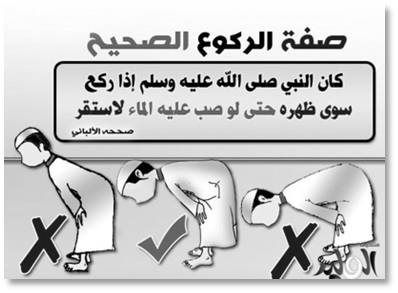
33. Then he performs the rukūʾ (bowing) by placing the palms of his hands on his knees, spreading his fingers as if he is holding them firmly. He must stretch out his back keeping it straight and level, such that if some water was poured onto it, it would settle there. The head should not be dipped, nor raised high but instead, level with the back. He should keep his elbows away from touching his sides.27
34. He recites the following in the rukūʾ:28
سبُْحْاََنَ َرَبِّ َيِّ َ الْعْظِيمْا ْلعَ ِظيْمِ
“Subḥāna Rabbīyal-ʿadhīm.”
(Glorified is my Lord, free and far-removed from all imperfections, the Supreme). He should repeat this three times or more.29
35. It is not permitted to recite the Qurʾān in the rukūʾ (bowing) or sujūd (prostration).30
36. Then he raises up from rukūʾ and straightens his back making himself upright, and as he comes up from the rukūʾ he recites: سَمَِعَ اللَّ هلهُ لِمَْنْ حمِدحَ ِم َد ُهَ ُهَُ
“Samiʾ Allāhu liman ḥamidah.”
(Allāh listens and responds to the one who praises Him).
Once he is upright, he raises his hands as he did when he first entered the Prayer to the level of his shoulders (see point 19).31
37. He stands until all of his bones return to their place (and puts his hands by his sides) and then he recites the following:32
َرَبََّ َنَّ َاَ ولََكَوَ َلكَ الْحْمَُْدُ
“Rabbanā wa lakal-ḥamd.”
(Our Lord! And all praise is for You).
338. Then he says:3 اللَّ هَّ لهُ أكْ َبَْرَ
“Allāhu-akbar.”
(Allah is greater than all else).
39. He then prostrates on the ground (sujūd) with his hands being placed on the ground first, before his knees. 34 He brings his fingers together on the ground, he rests on his hands and puts them forward, pointing his fingers towards the Qiblah.35

40. He keeps his elbows and forearms lifted above the ground, and not spread out on the ground in the manner of a dog.36
41. In sajdah (prostration), he firmly places his forehead, nose, hands, knees and toes on the ground as in the illustration.
42. He keeps his feet upright with the toes pointing towards the Qiblah and his heels joined together.
43. He must be settled in his sajdah and be still in that state,37 with his forehead, nose, palms of the hands, both knees and the toes of both feet in contact with the ground.38
44. In sajdah (prostration), he recites:
سبُْحْاََنَ َرَبِّ َيِّ َ الاعْٔ َلَْىَ
“Subḥāna Rabbīyal-Aʾlá.”
(Glorified is my Lord, free and far-removed from all imperfections, the Most High).
He should recite this three times or more. It is recommended to be plentiful in supplicating to Allāh while in sajdah because it is a moment most suited for supplications to be answered. One should not recite the Qurʾān in sajdah39 unless the supplication is found in the Qurʾān.
45. The rukūʾ (bowing) and sujūd (prostration) should be similar in length.40
46. It is allowed to prostrate on the earth or on something that covers it, such as a cloth, carpet or mat.41
47. Then he raises his head whilst saying:
اللَّ هَّ لهُ أكْ َبَْرَ
“Allāhu-akbar”,42 and he sits allowing every bone to settle. His sitting is such that he lays his left foot flat underneath him and sits on it, and he keeps his right foot upright with his toes pointing in the Qiblah direction as in the picture.43

48. Whilst sitting he recites:44
اللَّ هَّ ُمَُّ اغفِْرِاغْ ِفرْ ِلِيِ، واَرْحْمَِْنِيِ، واَجبُْرُنِْيِ، واَرْفَعَْ ِنِْيِ، وعَاَفِ ِنِِيِ،
واَرْزقُْ ِنِْيِ
“Allāhummagh-firlī, war-ḥamnī, waj-burnī, warfaʾnī wa ʿāfinī, war-zuqnī.”
(O Allāh, forgive me, have mercy on me, suffice me, raise me in rank, grant me safety and wellbeing, and provide for me).
Or he can recite:
َرَبَِّ اغفِْرِاغْ ِفرْ ِلِيِ، َرَبَِّ اغفِْرِاغْ ِفرْ ِلِيِ
“Rabbigh-firlī, Rabbigh-firlī.”
(O Lord forgive me. O Lord forgive me).
49. Then he says “Allāhu-akbar” and returns to make the second sajdah (prostration) just as he made the first one, repeating the same words (point 44).45
50. Then he raises his head and sits as he sat before until his bones rest in place and he remains stationary for a moment before standing for the second rakʿah.46
The Second Rakʿah
51. To stand for the second rakʿah, he supports himself on his two fists clenched as if he is kneading some dough for bread, and he returns to the
standing position as he was in the first rakʿah.47
52. In the second rakʿah he recites what he recited in the first rakʿah but without the opening supplication. So, he begins with, “Bismillāh ir-Raḥmān irRaḥīm” followed by the Sūrah Al-Fatiḥah, and then he recites whatever is easy for him from the Qurʾān. The second rakʿah should be made shorter than the first.48
53. After this rakʿah, he makes rukūʾ (bows), returns back to standing upright, and then makes the two sajdahs (prostrations) as he did previously.
The First Sitting and Tashahhud (Reciting the
Testification and Supplication)
54.

After the second
sajdah, he sits as he did before49 and clenches his right fist, resting it on
his right thigh and knee, his thumb over the middle finger, his index finger raised, pointing to the Qiblah, moving it up and down whilst keeping his vision fixed on it throughout the whole of this sitting.50 One may also make a circle with his middle finger and thumb (sometimes).51 He does not clench his left hand or raise its finger.52

The palm of his left hand, with fingers spread out, should rest on his left thigh and knee.

55. The words recited for the tashahhud in this seated position are:53
التحَّ ِياَّ ت ِللَِّ ِه، وَاَلصِلَّ َوَاَت، وَاَلطَّ ـيـِّ بَاَت، َاَلَسلَّ اَ ُمَُ عَِ َلََىَِ النَّ ِبِيِّ
ورََحَُمَْةَ اللَّ هَّ وبَرَكََاَتهُُ، َاَلَسلَّ اَُمُ علََيَُْ َنَْاَ وعََ َلََىَ عبَاَِد اللَّ هَّ ِاِلصاَّ لِحِيُِْ َنَُْ، أشْهَْ ُدَُ أْنْ لُاَّ إلَهَإ َلهَ إلاَّ اللَّ هَّ لهُ، وأَشْهَْ ُدَُ ٔانَّ ٔ مُحُمَّ ًَدًاً
عبَدُُْهُ ووَ َررَسَُوُلُهُُسو ُلهُ
“At-taḥīyyātu lillāhi waṣ-ṣalawātu, waṭ-ṭayyibātu, as-salāmu ʿalan-Nabī, wa raḥmatullāhi wa barakātuhu. As-salāmu ʿalaynā wa ʿalá ʿibādillāhiṣṣāliḥīn. Ash-hadu an lā ilāha illallāh, wa ash-hadu anna Muḥammadan ʿabduhu wa rasūluh.”
(Words of praise, exaltation and glorification are for Allāh alone, and Prayers, worship and pure words and attributes also. May Allāh send peace and security upon the Prophet, and His Mercy and Blessings. May Allāh send peace and security upon us and upon His righteous servants. I bear witness that none has the right to be worshipped except Allāh, and I bear witness that Muḥammad is His servant and Messenger).
56. After that, he should supplicate with the following words:54
اللَّ هَّ ُمَُّ َصلِّ َ عَ َلََىَ مُحُمََّ ٍدَّ ٍ، وعََ َلََىَ آِلِ مُحُمََّ ٍدَّ ٍِ، كَ َمََاَ َصلَّ َيَّ تْ عَ َلََىَ إبرْاَهِيمْإبْرَا ِهيْمَ وعََ َلََىَ آِلِ إبرْاَهِيمْإبْرَا ِهيْمَ، إن َّككَ حمِيِحَ ِميْ ٌدْ ٌدٌْ مَجَيْ ٌدٌْ، َاَلَلَّ هَّ ُمَُّ باَرِ َ ْكَِْ عَ َلََىَ
مُحُُمحَمَّ ٍدٍ، وعََ َلََىَ آِلِ مُحُمَّ ٍدٍ، كََمَاَ باَرَكْتبَا َر ْكتَ عَ َلََىَِ إبرْاَهِيمإبْرَا ِهيْمَ وعََ َلََىَ آِلِ
إبرْاَهَِيمْإبْرَا ِهيْمَ، إنكَّ كَ حمِيحَ ِميْ ٌدْ ٌدٌْ مَجَيْ ٌدٌْ
“Allāhumma ṣalli ʿalá Muḥammad wa ʿalá āli
Muḥammad, kamā ṣallayta ʿalá Ibrāhīm wa ʿalá āli Ibrāhīm, innaka Ḥamīdun Majīd. Allāhumma bārik ʿalá Muḥammadin wa ʿalá āli Muḥammad, kamā bārakta ʿalá Ibrāhīm, wa ʿalá āli Ibrāhīm, innaka Ḥamīdun Majīd.”
(O Allāh, extol and honour Muḥammad and the true followers of Muḥammad, just as you extolled and honoured Ibrāhīm and the pious offspring of Ibrāhīm. Indeed, you are due all praise, perfect in glory and magnificence. O Allāh, send your blessings on Muḥammad and on the true followers of
Muḥammad, just as you sent blessings on Ibrāhīm and on the pious offspring of Ibrāhīm. Indeed, you are deserving of all praise, perfect in glory and magnificence).
The Third and Fourth Rakʿāhs
57. Then he says اللَّ ُهُ أكْ َبَْرَ “Allāhu-akbar”, he should raise his hands sometimes (to shoulder height) as he did when beginning the Prayer55 and then stand for the third rakʿah.
58. To stand for the third rakʿah, he supports himself on his two fists clenched as if he is kneading dough.56 He returns to the standing position as he was in the first rakʿah.
59. In the third and fourth rakʿahs he recites Sūrah
Al-Fātiḥah beginning with “Bismillāh ir-Raḥmān irRaḥīm”
The Final Tashahhud and Sitting till the End of the Prayer
60. After finishing the final rakʿah he performs the rukūʾ, rises from it, and then prostrates (sujūd) twice and sits to recite the tashahhud as he did after praying the first two rakʿahs.

61. If this sitting is after the third rakʿah (as in Maghrib Prayer) or after the fourth rakʿah (as in Ẓuhr, ʿAṣr and ʿIshā prayers), then he should sit, if he is able, and without harming or restricting those next to him, as follows: with the left hip/buttock on the ground, his left foot settles under his right shin, and his right foot is upright next to his right hip, and his toes are directed to the Qiblah. This is called tawarruk (see the illustration).57
62. He may also sit as he sat in the first tashahhud if he is praying in congregation and fears that he may constrict fellow worshippers.58
63. He places his left hand on his left knee and is supported by that knee. He clenches his right hand into a fist as he did in the first tashahhud, he places it on his right thigh and knee and points his index finger and looks at it.

64. Once he has settled in this position, he recites what he recited in the first tashahhud exactly.
َاَلَتحَّ ِيِاَّ ت ِللَِّ هَّ ، وَاَلصِلَّ َوَاَت، وَاَلطَّ ـيـِّ بَاَت، َاَلَسلَّ اَ ُمَُ عَ َلََىَ النَّ ِبيِِّ
ورََحَُمَْةَِوَ َرحْ َمةُ اللَّ هَّ وبَرَكََاَتهُُوَبَرَ َكاتُهُ، َاَلَسَّ لاَُمُ علََيَُْ َنَْاَ وعََ َلََىَ عبَِاَِدِ اللَّ هَّ ِاِلصاَّ لِحِيِْ َنَْ، أشْهَْ ُدَُ أْنْ لاَّ إلَهَ إلاَّ اللَّ هَّ لهُ، واَشْٔهَْ ُدَُ ٔأنَّ مُحُمََّ ًدًاً
عبَْدُُهُ ووَ َررََسَُوُلُهُُسو ُلهُ
“At-taḥīyyātu lillāhi waṣ-ṣalawātu, waṭ-ṭayyibātu, as-salāmu ʿalán-Nabī, wa raḥmatullāhi wa
barakātuhu. As-salāmu ʿalaynā wa ʿalá ʿibādillāhiṣṣāliḥīn. Ash-hadu an lā ilāha illallāh, wa ash-hadu anna Muḥammadan ʿabduhu wa rasūluh.” Followed by:
اللَّ هَّ ُمَُّ َصلِّ َ عَ َلََىَ مُحُمَّ ٍَدٍ، وعََ َلََىَ آِلِ مُحُمََّ ٍدَّ ٍ، كَ َمََاَ َصلَّ َيَّ تْليْتَ عَ َلََىَ
إبرْاَهِيمْإبْرَا ِهيْمَ وعََ َلََىَ آِلِ إبرْاَهِيمْ، إنككَ حمِيِْ ٌدٌْ مَجَيْ ٌدٌْ، َاَلَلَّ هَّ ُمَُّ باَرِْكْ عَ َلََىَ مُحُُمحَمَّ ٍدٍ، وعََ َلََىَ آِلِ مُحُُمحَمَّ ٍَدٍَ، كََّ َمَّ َاَ باَرََكْتبَا َر ْكتَ عَ َلََىَِ إبرْاَهِيمإبْرَا ِهيْمَ وعََ َلََىَ آِلِ إبرْاَهِيمْإبْرَا ِهيْمَ، إنكَّ كَ حمِيحَ ِميْ ٌدْ ٌدٌْ مَجَيَمجِيْ ٌدْ ٌدٌْ
“Allāhumma ṣalli ʿalá Muḥammad wa ʿalá āli Muḥammad, kamā ṣallayta ʿalá Ibrāhīm wa ʿalá āli Ibrāhīm, innaka Ḥamīdun Majīd. Allāhumma bārik ʿalá Muḥammadin wa ʿalá āli Muḥammad, kamā bārakta ʿalá Ibrāhīm, wa ʿalá āli Ibrāhīm, innaka Ḥamīdun Majīd.” Then he adds at the end of that, the following supplication, seeking refuge with Allāh from four
59matters:اللَّ هَّ ُمَُّ إنيِِّ أعٔوُْ ُذُْ بكِ مِْنْ عذََِاَب جهَنَّ َمَّ نمَ، ومَِِْنْ عذََاَبِ الْقَبْرْ، ومَِْنْ فِتِنَْةَ الْمَحَيَْاَ واَلَْمَمَاَت، ومَِِْنْ َشَرَِّ فِتِنَْةَ الْمَسِيِحْ اِلدَّ جَّ اَّ ِِلِ
“Allāhumma innī aʾūdhubika min ʿadhābi jahannam, wa min ʿadhābil-qabr, wa min fitnatil-maḥyā walmamāt, wa min sharri fitnatil-Masiḥ id-Dajjāl.”
(O Allāh, I seek refuge with you from the punishment of Hellfire, and from the punishment of the Grave, from the trials of life and death, and from the tribulation of the False Messiah).
65. Then he may supplicate to Allāh for whatever he pleases from the authentic supplications of the Book and the Sunnah; and these are plentiful. However, if he does not know them or has not memorised them, he may still ask Allāh, uttering any supplication that is easy for him; seeking from Allāh benefit for himself in his religious and worldly affairs.60
Salutations at the End of the Prayer (Taslīm)
66. Then he turns his head to the right side and says:
َاَلَسلَّ امَلاَمُ علََيْکْمعَ َل ْيکُمْ ورَحَْمَُةُ اللَّ ه
“As-salāmu ʿalaikum wa raḥmatullāh.”
(May Allāh’s peace and security be upon you, and His Mercy).
67. Then he turns his head to the left side and says:61
َاَلَسلَّ امَلاَمُ علََيْکْمعَ َل ْيکُمْ ورَحَْمَُةُ اللَّ ه
“As-salāmu ʿalaikum wa raḥmatullāh.”
(May Allāh’s peace and security be upon you, and His Mercy).
With that, he completes his Prayer just as Allāh’s Messenger () taught his followers.
And all praise is due to Allāh, Lord of all creation.
Purification (Wuḍū) and Prayer in Islam: its Times, its Pre-Conditions and Virtues
Muslims are obligated to pray to Allah five set times each day. This Prayer is called ṣalāh in Arabic. It is the second pillar of Islām. Muslims dedicate a portion of their time throughout the day to focus upon this special act by supplicating and reciting to Allāh. The term ṣalāh in the Arabic language means supplication (duʿāʾ) and in the religious usage it refers to the five daily Prayers that are obligated upon every adult and sane Muslim male and female.
Prayer Times
The Prayer times are worked out from the authentic narrations of the Prophet Muḥammad (). The Angel Jibrīl visited the Prophet Muḥammad () over two days. On the first day he led the Prophet at the earliest times of the Prayers. On the second day, he led him at the end times of each of the Prayers. The five Prayer-times are based around three daily events: sunrise, midday, and sunset. These times alter greatly between the seasons of summer and winter – and even by country. In Britain, winter Prayer times are very different to summer Prayer times. Each Prayer is announced by the adhān (the call to Prayer), which is traditionally called by a mu’adhin who stands just outside the Mosque and calls Muslims to perform the Prayer. Nowadays people have the adhān recorded into their phones or clocks to remind them of the Prayer times.
The Prophet () said: “Jibrīl led me in Prayer twice at the Kaʿbah in Makkah. So, he prayed Ẓuhr the first day when the shadow was similar to the length of the strap of a sandal (i.e. just after midday). He then prayed ʿAṣr when an object was similar to the length of its shadow. Then he prayed Maghrib after the sun had set and the fasting person breaks the fast. Then he prayed ʿIshā when the twilight had vanished. Then he prayed Fajr when the true dawn began (before sunrise), and when eating is prohibited for the fasting person. On the second occasion he came, he prayed Ẓuhr when the shadow of an object was similar to the length of it, which was the time of ʿAṣr starting the day before. He then prayed ʿAṣr when the shadow of an object was about twice as long as it. He then prayed Maghrib at the same time as he did the first time. He then prayed ʿIshā when a third of the night had gone (just before midnight). He then prayed Fajr when the land glowed (before sunrise). Jibrīl then turned towards me and said, ‘O Muhammad, these are the times of the Prophets before you, and the Prayer-time is what is between these two times.’”62
So, in summary, the Prayer-times are as follows:
1. Fajr: After the true dawn but before sunrise.
2. Ẓuhr: Just after midday till the shadow of an object is the same as its length.
3. ʿAṣr: When the shadow of an object is the same as its length until it is twice its length.
4. Maghrib: Just after the sunset until ‘Ishā begins.
5. ʿIshā: When the twilight vanishes till half the night has passed. Twilight is the light (or glow) that remains in the western horizon after the sun goes down.
Conditions of the Prayer
The Prayer also has conditions — and without them, the Prayer is not valid:
1. Islam. A person must be a Muslim.
2. Sanity. The insane person is not obligated to pray. 3. Adulthood. This is known by: coarse hair in the private areas, discharge of sexual fluid, reaching the age of fifteen, the onset of menstrual bleeding (in females). Whichever of these occurs first, adulthood is reached.
4. Purification. Ablution with water (wuḍū) and if there is no water, then with the earth (tayammum). 5. Covering the important parts of the body (ʿawrah) with loose-fitting, non-transparent garments. The woman covers everything except her face and hands. The man must cover himself from the navel to the knees, and his shoulders.
6. One’s body, garments and place of Prayer must be clean of impurities such as urine and excrement. Soil, food stains, oil, paint, etc. are not impure.
7. Facing the direction of the Qiblah (Makkah) during the Prayer.
8. A sincere intention of the heart — and not by utterance with the tongue. This is to know which Prayer one is about to perform, and to make it sincerely for Allāh.
9. Time: Making sure that each Prayer is prayed within the correct time.
Wuḍū (Ablution) For The Prayer
The method of wuḍū (ablution) is explained in the Qurʾān: “When you stand for Prayer, wash your faces, and your hands up to the elbows. Then wipe your heads and wash your feet up to your ankles.”63 In the authentic narrations, the Companions explained the wudū of the Prophet (): He washed his hands three times, then rinsed his mouth and sniffed water in his nose (in one motion) and blew it out. He then washed his face three times. Thereafter he washed his right hand up to and including his elbow three times, then the left one likewise. Then he wiped his head with his wet hands, from his forehead up to (and not including) the nape of his neck and then back to his forehead. Then he put his index fingers into his ears and the thumb behind the ear lobes. Then he washed his right foot up to the ankle three times, then the left one likewise. In one narration, ʿUthmān () said, “I saw Allah’s Messenger () performing ablution (wudū) like this ablution of mine.”64 The guidance of the Prophet is that “with one handful of water he rinsed his mouth and cleaned his nose by sniffing water into it and then blowing it out.”65 There are also narrations that mention that each limb can be washed once, twice or three times.66 To exceed upon three is not from the Sunnah.
Once the feet have been washed, and socks or other footwear worn, a person can wipe wet hands over the footwear for a whole day during subsequent ablutions — and a traveller can do that for up to three days so long as the footwear is not removed. Allah's Messenger () said, “When one of you enters his feet into his socks whilst they are pure, then you should wipe over them: three days for the traveller and one day for the resident.”67 The Companion, ʿAlī Ibn Abī Ṭālib (), said, “The Prophet () made it a day and a night for the resident, and for the traveller three days and nights, meaning: wiping over the socks.68 Mughīrah Ibn Shu’bah () said, “The Prophet () made wuḍū and he wiped over his socks and
sandals or shoes.”69
When water is not available, then a dry purification (tayammum) is performed, which proves the obligation of purification before Prayer. It is reported that “The Prophet () struck the soil of the earth with the palms of his hands, then blew off the dust, and wiped his face and rubbed his hands.”70 The earth and its soil are physical and spiritual purifiers.
Facing Makkah (the Ka’bah): Muslims face Makkah during the Prayers. Hundreds of millions of Muslims throughout the world stand united in worship focussed in a singular direction of Prayer, worshipping Allah alone and rejecting the worship of everything besides Him whether it be Prophets, saints, idols, the Sun, the Moon and so on. This Prayer is normally performed in mosques — and it is obligatory for a man to pray in a mosque if he hears the adhān (the call to Prayer) coming from it. However, even if Muslims do not hear it, they are still obligated to pray wherever they are.
The Prophet () said, “The whole of the earth has been made for me as a place of purification and Prayer.” However, Muslims are not permitted to perform the daily Prayers in toilet areas or in a graveyard, nor are they permitted to bury their deceased ones in a mosque, as that leads to grave-worship and calling upon the dead for intercession. The Prophet () said, “Allah cursed the Jews and Christians because they turned the graves of their Prophets and righteous into places of worship.”71
So, a Muslim must not miss the Prayer. The Prophet () said, “Between a person and between polytheism and disbelief is the abandonment of the Prayer.”72 The Prayer holds a mighty position in Islam. Sadly, in these times we see many Muslims neglecting it — and one can see the effects of the abandonment of the Prayer in their lives, in the lives of their families and in the moral fabric of society. Allah (the Most High) sends His bounties and blessings on those who worship Him, and He guides them, so long as they hold fast to the Sunnah and worship Him alone. Then, in the life after death, He rewards them beyond their imagination!
The Five Daily Prayers Are Worth Fifty In Reward
Allah’s Messenger () was taken into the
Heavens on a night journey. He said afterwards, “Allah said to me, ‘These are the five daily Prayers and they are equal in reward to fifty, and My word does not change.’ Then Angel Jibrīl took me until we reached the Lote Tree of the utmost boundary which was shrouded in colours indescribable. Then I was admitted into Paradise where I found low walls made of pearls and the soil was of musk.”73
Guard The Prayers, Especially The Middle Prayer
The Prophet () said, “Whoever misses the
‘Asr Prayer, then it is as if he has lost his family and property.”74
When An Affair Troubles You, Seek Solace By
Praying
Ḥudhaifah Ibn Yamān () said, “Whenever something serious troubled the Prophet
(), he would pray.”75
The Coolness Of The Eyes And Comfort Of The Soul
The Prophet () said, “Women and perfume have been made dear to me, and the coolness of my eyes is in the Prayer”76
The Prayers Wipe Away Sins
The Prophet () said, “Between each of the five daily Prayers, a Jumuʿah (Friday Prayer) to the next Jumuʿah, and a Ramaḍān till the next Ramaḍān are an expiation for whatever is committed between them so long as one keeps clear of the major sins.”77 The Prayer is a lifeline for Muslims and must never be abandoned. A Muslim, no matter how sinful, should always return to Allah, pray to Him, seek His forgiveness and mercy because Allah, the Lord of the worlds, is truly Oft-Forgiving and Most Merciful.
Endnote
The description of the Prophet’s Prayer above is an illustrated, abridged and edited translation of the book, “Talkhīs Ṣifat As-Ṣalāh An-Nabī ()” with each point referenced back to the origin of that small work by the Shaikh, the Scholar of Hadīth and Sunnah, Muḥammad Nāṣir Al-Dīn Al-Albānī (may
Allāh have mercy upon him), entitled, “Aslu Ṣifatis- Ṣalātin-Nabī () minat-Takbīr ilat-Taslīm ka annaka Tarāhā” printed in three volumes by Ma’ārif Publications, Riyadh, 2006. In that work, for each point, Shaikh Al-Albānī provides detailed proofs from authentic ahādīth, with connected chains of narration (asānīd) leading back to Allāh’s Messenger (), his Companions and the early scholars of Ahlus-Sunnah. The Shaikh referenced each minute point of the Prayer to an authentic narration collected by the well-known scholars of Hadīth. For this reason, I have referenced every aspect of the Prayer back to that three-volume work of the Shaikh. I have added additional minor points for clarity and left out others to keep the description as simple as possible for one who is learning to pray according to the Sunnah. Occasionally, I found myself searching for a more appropriate word for translation, so I referred to an earlier translation of “Talkhīs Ṣifat As-Ṣalāh An-Nabiyy ()” by our brother, Abū Ṭalḥah Dāwūd Burbank (). Finally, anyone who wishes to read the evidences for any point, you can email me at ak@salafipubs.com and I will send you the source references for any point (inshā’-Allāh), or you can purchase the Arabic three-volume work of Shaikh Al-Albānī ().
1 Aslu Ṣifatis-Ṣalāh An-Nabī () min At-Takbīr IlatTaslīm ka Annaka Tarāhā, by Al-Albānī 1/55.
2 Ibid., 1/58-59.
3 Ibid., 1/72
4 Ibid., 1/79-86 5 Ibid., 1/91.
6 Ibid., 1/65, 1/104.
7 Ibid., 1/61.
8 Ibid., 1/101.
9 Ibid., 1/108.
10 Ibid., 1/114.
11 Ibid., 1/140.
12 Ibid., 1/114.
13 Ibid., 1/130.
14 Ibid., 1/174.
15 Ibid., 1/175.
16 Ibid., 1/193.
17 Ibid., 1/205,209.
18 Ibid., 1/230.
19 Ibid., 1/238.
20 Ibid., 1/270-275.
21 Ibid., 1/277.
22 Ibid., 1/300.
23 Ibid., 1/321.
24 Ibid., 1/391.
25 Ibid., 1/327-372 and 2/413-415.
26 Ibid., 2/601.
27 Ibid., 2/626.
28 Ibid., 2/650.
29 Ibid., 2/257.
30 Ibid., 2/669.
31 Ibid., 2/674.
32 Ibid., 2/682.
33 Ibid., 2/706.
34 Ibid., 2/720.
35 Ibid., 2/725.
36 Ibid., 2/746.
37 Ibid., 2/760.
38 Ibid., 2/738.
39 Ibid., 2/761.
40 Ibid., 2/772.
41 Ibid., 2/780.
42 Ibid., 2/798.
43 Ibid., 2/801.
44 Ibid., 3/809.
45 Ibid., 3/815.
46 Ibid., 3/816.
47 Ibid., 3/824.
48 Ibid., 3/824-827.
49 Ibid., 3/829.
50 Ibid., 3/852.
51 Ibid., 3/850.
52 Ibid., 3/838.
53 Ibid., 3/870.
54 Ibid., 3/904.
55 Ibid., 3/952.
56 Ibid., 3/953.
57 Ibid., 3/987.
58 Ibid., 3/983,988.
59 Ibid., 3/998.
60 Ibid., 3/1002. 61 Ibid., 3/1023
62 At-Tirmidhī, 149.
63 Qur’ān 5:6.
64 Bukhāri, Muslim and others.
65 Ibid.
66 Bukhāri, 191.
67 Sahīh Al-Jāmi, 1/195.
68 Muslim, 276.
69 At-Tirmidhī and Abu Dāwūd, 159.
70 Al-Bukhārī, 343.
71 Al-Bukhārī.
72 Muslim, 88.
73 Al-Bukhārī, 349.
74 Al-Bukhāri, 543.
75 Abu Dāwūd, 1319.
76 An-Nasā’i, 3940.
77 Muslim, 233/344.


